 Live Greyhound Betting
 BAGS Greyhound Racing Explained | What It Is & Why It Matters
 Available in US
BAGS greyhound racing explained. What Bookmakers' Afternoon Greyhound Service is, how it differs from GBGB evening racing, and why BAGS meetings dominate UK betting.
The Engine Room of Daily Greyhound Betting
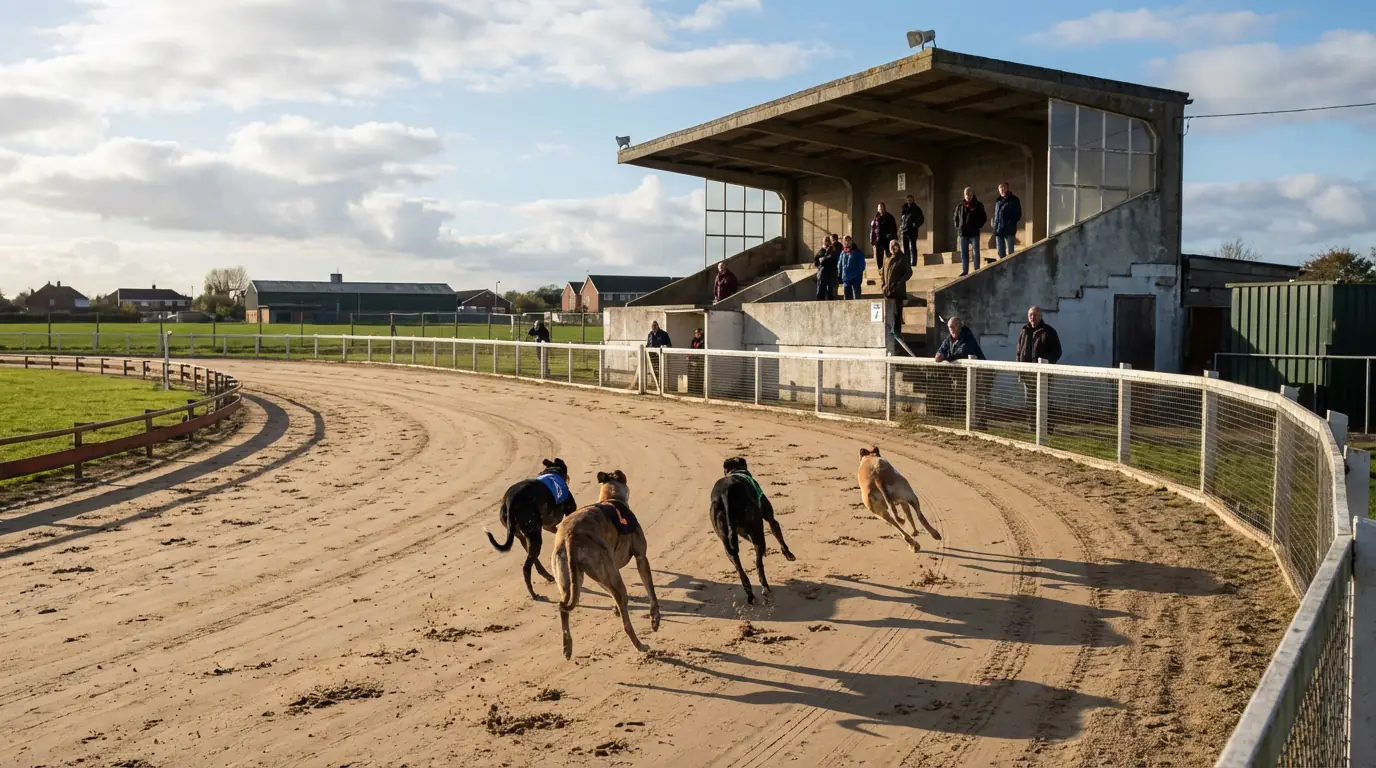
If you bet on greyhounds in the UK with any regularity, the overwhelming majority of your wagers are placed on BAGS racing — whether you know it or not. BAGS stands for the Bookmakers’ Afternoon Greyhound Service, and it is the framework that supplies the daily schedule of greyhound fixtures to licensed betting shops and online bookmakers across Britain. Without BAGS, the continuous stream of afternoon and daytime greyhound racing that fills betting shop screens and online sportsbooks would not exist in its current form.
BAGS racing is not a separate type of greyhound racing. The dogs are real, the tracks are licensed by the Greyhound Board of Great Britain, and the results count toward each dog’s official form record. What makes BAGS distinctive is its purpose: it exists primarily to service the betting industry by providing a reliable pipeline of races throughout the day, giving punters something to bet on between the morning and the evening open meetings. Understanding what BAGS is and how it operates gives you useful context for interpreting greyhound form, assessing market quality, and judging the competitive level of the races you bet on.
What BAGS Stands For and How It Works
The Bookmakers’ Afternoon Greyhound Service was established to create a structured schedule of daytime greyhound racing specifically for off-course betting. Before BAGS existed, greyhound racing was largely an evening and weekend activity, tied to on-course attendance and the social culture around the tracks. As betting shops expanded and eventually moved online, demand grew for live racing content during hours when there were no evening meetings. BAGS was the industry’s answer to that demand.
The service is funded through a levy system. Bookmakers who take bets on BAGS fixtures contribute a percentage of their greyhound racing turnover to the scheme, and those funds are distributed to the tracks that host BAGS meetings. This financial arrangement is the reason tracks can afford to race during less commercially attractive daytime slots — the BAGS levy effectively subsidises the fixtures.
BAGS meetings are staged at GBGB-licensed tracks across England and Wales. The tracks that participate in BAGS are the same venues that host evening open racing and major competitions, so the facilities and regulation standards are identical. The difference is in the scheduling and, to some extent, the competitive level. BAGS cards are designed to produce a steady flow of races — typically ten to fourteen races per meeting — at intervals of roughly fifteen minutes, providing a continuous stream of betting opportunities throughout the afternoon.
From a regulatory standpoint, BAGS races are governed by the same rules as all other GBGB-sanctioned racing. The grading system applies, non-runner rules apply, and the integrity framework that monitors for irregularities applies equally to a Tuesday afternoon BAGS card and a Saturday evening open meeting. The racing is legitimate and regulated. It is simply organised on a different commercial model — one designed to serve bookmakers and their customers rather than track-side spectators.
BAGS Fixtures and Scheduling
BAGS fixtures run every day of the year except Christmas Day. On a typical weekday, between three and five tracks will host BAGS meetings, with the first race going off around 10:30 in the morning and the final race finishing by mid-afternoon. The exact schedule varies by day, but the principle is constant: provide uninterrupted racing content from late morning through to the start of any evening fixtures.
The tracks rotate through the BAGS schedule on a regular basis. Some venues host BAGS meetings several times a week; others appear less frequently. The fixture list is published in advance and is available through the GBGB, on bookmaker sites, and on dedicated greyhound racing data platforms. If you want to know which tracks are racing on a given day and at what times, the information is always accessible.
Each BAGS meeting typically features between ten and fourteen races. The races are programmed at intervals of fifteen to eighteen minutes, which is fast enough to maintain momentum for bettors but allows sufficient time between races for trap loading, parade, and settlement of bets. This cadence is a deliberate design choice — it keeps the betting product engaging without overwhelming punters with simultaneous events across too many tracks.
One scheduling detail worth noting: BAGS meetings often overlap. Two or three tracks may be racing at the same time, with their race schedules staggered so that a race goes off at one track every few minutes. This creates a continuous sequence of greyhound races throughout the afternoon, even though no single track is racing non-stop. For punters, this means there is nearly always a race about to start somewhere, which is part of the appeal — and part of the discipline challenge. The constant availability of races can encourage impulsive betting if you are not selective about which races you engage with.
How BAGS Affects Betting Markets
BAGS racing has distinct market characteristics that set it apart from evening open meetings and feature events. Understanding those characteristics helps you calibrate your expectations and your approach.
Odds on BAGS races tend to be published later and with wider margins than on higher-profile meetings. Because the betting volume on an individual BAGS race is lower than on a Saturday evening open, bookmakers need higher overrounds to manage their risk. Expect overrounds of 125% to 135% on many BAGS fixtures, compared to 115% to 120% on well-attended evening meetings. That wider margin means slightly less value in the odds for the punter, though the effect on any single bet is modest.
Market liquidity is thinner. Fewer punters study BAGS form in detail compared to the big evening meetings, which means less money flows into the market and prices can be less efficient. This cuts both ways. On one hand, the odds may not accurately reflect a dog’s true chance because the market has not been pressure-tested by volume. On the other, a bettor who does study BAGS form carefully can find pricing errors that persist because there are not enough sharp punters to correct them. BAGS racing is arguably where the best opportunities exist for value-oriented greyhound bettors precisely because the market is less competitive.
The quality of competition in BAGS races is generally lower than in evening open racing. BAGS cards are graded racing — A3, A4, A5 and below — and while the dogs are genuine competitors, the overall standard is below the elite level you see in open events. For betting purposes, this means form can be less reliable as an indicator. Dogs at lower grades are often less consistent, and the margins between the first three finishers can be tighter and more volatile. Forecasts and tricasts on BAGS racing can produce unpredictable dividends because the finishing order is inherently less stable.
Live streaming coverage of BAGS meetings is comprehensive. Every BAGS fixture is streamed by the major bookmakers, and the access requirements are the same as for any other greyhound meeting. This means you can watch the dogs you are betting on, assess parade condition, and observe how they load into the traps — information that adds context to the form data, particularly at the lower grades where dogs may show more variance in their pre-race behaviour.
The Quiet Backbone of the Sport
BAGS does not generate headlines. It does not produce the sporting drama of a Greyhound Derby final or the betting-ring tension of a Saturday evening open at Hove. It is functional, routine, and designed above all to serve a commercial purpose — keeping the greyhound betting product alive and available across every hour that bookmakers are open for business.
But for bettors, BAGS is where the volume lives. It is where you will place the majority of your bets, where your form-reading skills are tested most regularly, and where the consistency of your approach is either rewarded or exposed. The races may not carry the prestige of open competition, but the money you win or lose on them is exactly as real. Treat BAGS with the same analytical respect you would give any other meeting, and the daily grind of afternoon racing becomes not just a betting opportunity but a testing ground for the methods that define your long-term results.
Understand BAGS greyhound racing on the livegreyhoundbetting homepage.
Compare BAGS with virtual betting in virtual betting.
