 Live Greyhound Betting
 Greyhound Sectional Times Explained | What Split Times Reveal
 Available in US
Greyhound sectional times explained. What split times at each bend reveal about early pace, finishing speed and running style, and how to use them in UK betting.
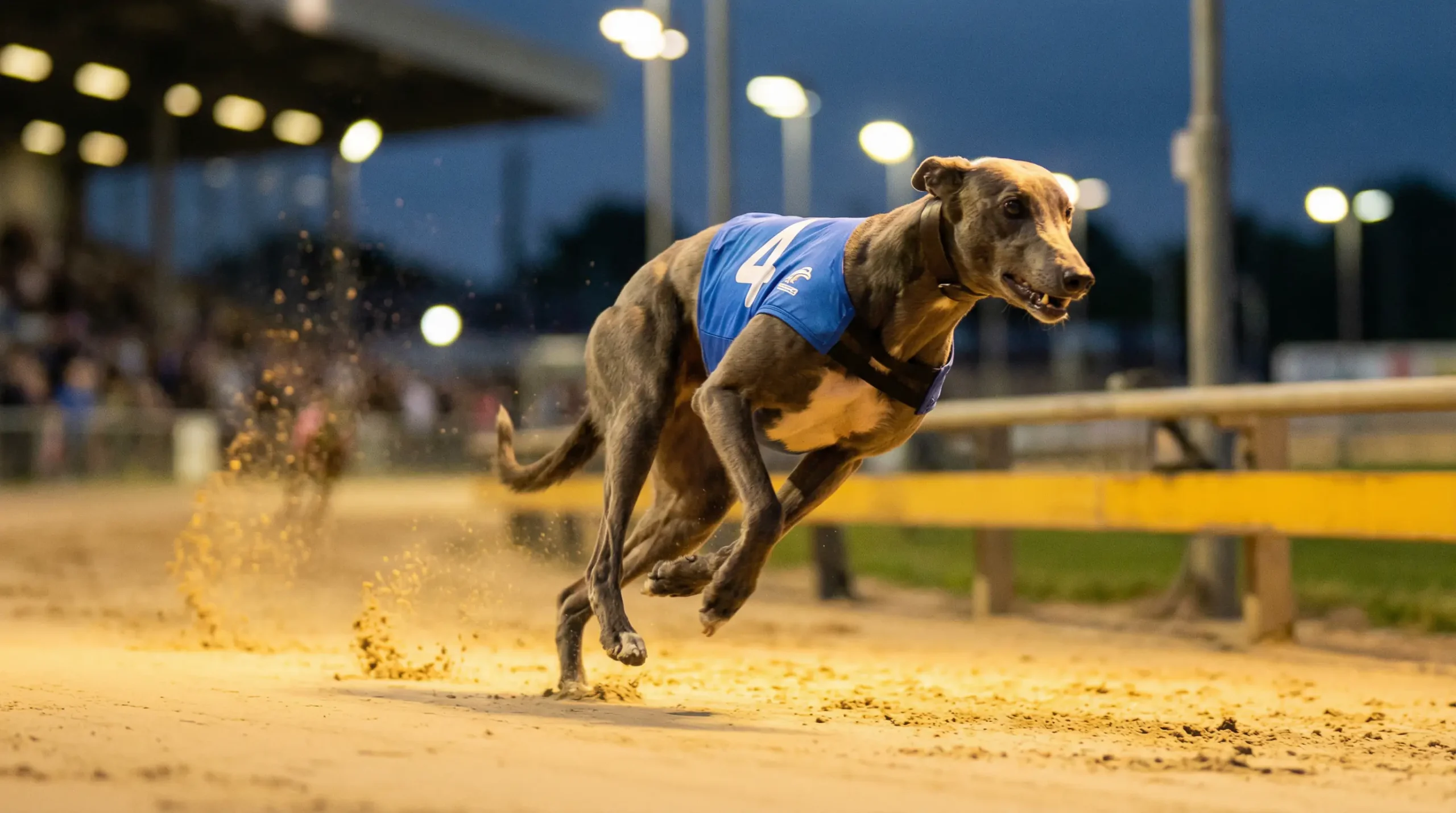
The Clock Tells You More Than the Result
A finishing position tells you where a greyhound ended up. A sectional time tells you how it got there. That distinction is the difference between surface-level form reading and genuine race analysis, and it is the reason experienced greyhound bettors pay as much attention to split times as they do to win-loss records.
Sectional times break a race into segments — typically the run to the first bend and the run from the final bend to the finish line — and measure how fast a dog covered each segment. A dog that clocks a fast first split but a slow run-home is a front-runner that fades. A dog with a slow first split but a rapid finish is a closer that stays on. Both dogs might record the same overall time, but the distribution of speed across the race tells completely different stories about their racing style, their stamina, and the conditions under which they are most likely to win.
This guide explains what sectional times are, how to read early-pace and run-home splits, and what the difference between calculated and actual times means for your betting analysis.
What Are Sectional Times in Greyhound Racing
Sectional times are the time taken by a greyhound to complete a defined portion of the race distance. In UK greyhound racing, the most commonly recorded sectionals are the time to the first bend and the time from the final bend to the line, though the exact measurement points vary by track.
The first-bend split is the most analytically useful sectional. It measures the dog’s early pace — how quickly it breaks from the traps and reaches the first bend. This split typically covers the first forty to eighty metres of the race, depending on the track’s layout. A fast first-bend time indicates strong early speed, which correlates with a dog’s ability to secure a leading position and dictate the race. A slow first-bend time suggests the dog is a mid-pack or back-running type that relies on pace through the middle and closing stages.
Run-home times measure the final segment of the race, from the last bend to the finishing line. This split reveals a dog’s finishing speed and stamina. A strong run-home indicates that the dog is still accelerating or maintaining speed in the closing stages — a trait associated with closers and dogs with deep reserves of stamina. A weak run-home suggests the dog is tiring, which may indicate it is being run over a distance that stretches its stamina range or that it has expended too much energy in the early part of the race.
Not all form guides display sectional times prominently. The GBGB publishes official times, and dedicated greyhound data services offer detailed split-time breakdowns. Some bookmaker race cards include sectionals; others show only overall times. If your primary platform does not display sectional data, seek it out from a specialist source — the investment of time in finding and studying splits pays dividends in the quality of your analysis.
Split Times: Early Pace and Run-Home Segments
The early-pace split is the single most predictive sectional in greyhound racing. Dogs with consistently fast first-bend times are more likely to lead the race and avoid the interference that commonly occurs through the first two bends. In a six-dog field running into a tight first bend, the dog that arrives first has the cleanest passage. Every dog behind it is at risk of bumping, checking, or being forced wide. Fast early pace translates into positional advantage, which translates into a higher probability of winning.
When comparing early-pace splits across the field, look for separation. If one dog consistently runs first-bend splits half a second faster than the rest of the field, it has a strong likelihood of leading into the first bend unchallenged. If two or three dogs have similar early speed, the first bend becomes contested — and contested first bends produce crowding, interference, and unpredictable outcomes. A race where multiple dogs have fast early pace is a fundamentally different betting proposition from one where a single dog has a clear pace advantage.
Run-home splits are less predictive in isolation but become valuable in specific contexts. A dog with a strong run-home is well suited to races where the early pace is fierce and the leaders are likely to tire. If you have identified through early-pace analysis that several front-runners will contest the lead, a closer with a fast run-home becomes a more attractive selection — it can pick up the pieces as the leaders fade through the final bend and home straight.
Comparing a dog’s early-pace split with its run-home split reveals its speed distribution profile. A dog with a fast early split and a slow run-home is front-loaded — it puts everything into the start and holds on. A dog with a moderate early split and a fast run-home is back-loaded — it builds through the race. These profiles are relatively stable for individual dogs and can be used to predict how they will run in future races. A front-loaded dog will almost always attempt to lead; a back-loaded dog will almost always close. Their split profiles confirm what their running style promises.
Track conditions affect split times. On a rain-softened surface, early-pace splits tend to slow because the heavier going reduces acceleration. Run-home splits may also slow, but not always proportionally — some dogs handle soft going better in the later stages when they are into their stride. Comparing sectionals from races run on different going is misleading unless you adjust for the conditions. Use sectionals from races at the same track on similar going for the most accurate comparisons.
Calculated Times vs Actual Times
The distinction between calculated times and actual times is one of the most important — and most underappreciated — concepts in greyhound form study. Actual time is the raw clock figure: the time from traps to line, measured by the official timing system. Calculated time is an adjusted figure that accounts for the interference, crowding, and wide running that a dog experienced during the race, estimating what the dog would have run if it had enjoyed a clear passage throughout.
Calculated times are published by specialist greyhound data providers. The adjustment process involves reviewing the running of each dog — noting where it was checked, bumped, forced wide, or impeded — and adding back the estimated time lost due to those incidents. The result is a figure that reflects the dog’s underlying ability rather than its actual performance on the day, which may have been compromised by circumstances beyond its control.
For bettors, calculated times are useful because they strip out the randomness that affects actual times. A dog that recorded a slow actual time because it was badly hampered at the second bend might have a calculated time that ranks among the fastest in its grade. If you relied only on the actual time, you would dismiss the dog as slow. The calculated time tells you it has the speed but was denied the opportunity to show it. That gap between actual and calculated performance is where betting value often hides.
However, calculated times have limitations. The adjustments are estimates, not measurements. Different data providers may calculate slightly different times for the same run based on their methodology. A dog that is consistently hampered — perhaps because of its running style or habitual trap draw — may have flattering calculated times that it never actually achieves in a clean run. Use calculated times as one input among several, not as the definitive measure of a dog’s ability.
The most powerful use of calculated times is in comparing dogs that have never raced against each other. If dog A has a calculated best of 29.40 at a particular track and dog B has a calculated best of 29.65 at the same track, you have a reasonable basis for assessing their relative speed — even if they have never appeared on the same race card. This cross-referencing is particularly useful when dogs move between grades or when an open race brings together runners from different parts of the grading ladder.
The Clock Does Not Lie — But It Does Not Tell the Whole Truth
Sectional times are among the most valuable tools available to a greyhound bettor. They reveal running style, identify pace advantages, expose dogs whose form has been compromised by interference, and provide a framework for comparing dogs across different grades and tracks. No other single data point offers as much analytical depth.
But times need context. A fast split at one track is not equivalent to a fast split at another — track geometry, surface condition, and weather all influence the numbers. A calculated time is an estimate, not a guarantee. And the fastest dog on paper does not always win the race on sand, because greyhound racing involves six animals running in close proximity at high speed, and things happen that no stopwatch can predict.
Use sectional times to sharpen your form study, not to replace it. Layer splits on top of finishing positions, grade movements, and trap draw analysis. The dogs whose form, splits, and conditions all align are the ones that deserve your attention — and your stake.
Master sectional times analysis on the livegreyhoundbetting homepage.
Combine sectional times with track conditions in track conditions.
