 Live Greyhound Betting
 Starting Price vs Early Price in Greyhound Betting | When to Take Odds
 Available in US
Starting price vs early price in greyhound betting explained. When to take the price, when to wait for SP, and how odds movement affects your UK greyhound bets.
Timing Is a Bet Within the Bet
Every greyhound bet involves two decisions: which dog to back, and when to take the price. The second decision gets far less attention than the first, yet it directly affects your returns. Backing a dog at 5/1 early in the market and watching it drift to 8/1 by the off means you left value on the table. Backing at 5/1 and watching it shorten to 3/1 means you locked in a better price than anyone who waited. The dog runs the same race either way. The difference is in your payout.
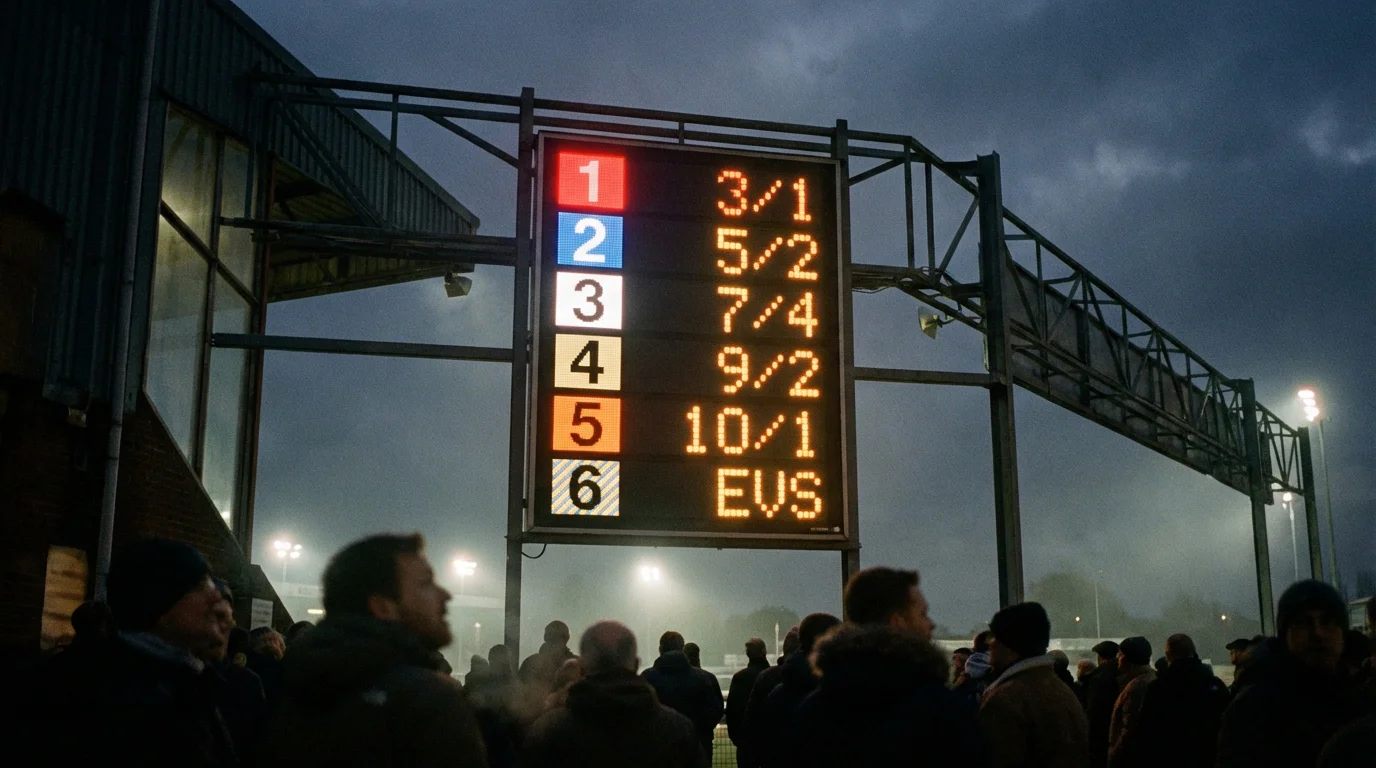
In greyhound racing, the timing question is sharper than in most other sports because the market window is compressed. Early prices on greyhound races are typically published ten to twenty minutes before the off — sometimes less. The odds can move significantly in that short window as money arrives, information circulates, and the on-course market settles toward the starting price. Understanding how SP and early price work, and when each option serves you better, is a practical skill that improves your returns without requiring any change to your selection process.
How Starting Price Is Determined
Starting price is the official odds on a greyhound at the moment the traps open. It is determined by the on-course market — the prices offered by bookmakers at the track immediately before the race begins. Officials at the track compile the SP by taking an average of the final prices offered by on-course bookmakers at the start of the race (Marathonbet Greyhound Rules). Note that unlike horse racing, where starting prices are overseen by the Starting Price Regulatory Commission (SPRC), greyhound SP has no equivalent independent regulatory body.
In practice, on-course bookmaker presence at greyhound tracks is far thinner than at horse racing meetings. Many BAGS fixtures run with minimal or no on-course betting activity, which means the SP is often derived from a smaller sample of prices than at a well-attended horse racing meeting. This can make greyhound SPs less robust as a market signal — they reflect the views of fewer participants, and the prices can be influenced by relatively small amounts of money.
For the bettor, SP means accepting whatever odds the market settles at by the time the race starts. You do not know the price when you place the bet. If the dog drifts — its odds lengthen because the market does not fancy it — you benefit from a bigger SP. If the dog steams — its odds shorten because money comes for it — you receive a lower SP than the early price would have given you. SP removes the timing decision by deferring to the market’s final assessment, but it also removes your ability to lock in a specific value.
One important structural point: when you bet at SP with a bookmaker that offers Best Odds Guaranteed, BOG does not apply. BOG requires you to take a fixed early price so there is a reference point to compare against SP (William Hill Greyhound Rules). If you bet at SP, there is no early price to guarantee — the SP is your price by definition. This means SP bettors cannot access one of the most bettor-friendly promotions available in greyhound racing.
Early Price: Locking In Before SP
Early price — sometimes called board price or fixed price — is the odds offered by a bookmaker before the race, which you accept at the time of placing your bet. Once you take the early price, your bet is locked in at that figure regardless of subsequent market movement. If the price shortens after you bet, you keep the higher number. If it drifts, you are stuck with the lower one — unless your bookmaker offers Best Odds Guaranteed, in which case a drift to a higher SP upgrades your payout automatically.
Early prices on greyhound races are published by bookmakers based on their own assessment of each dog’s chances. These prices appear on the betting platform anywhere from thirty minutes to ten minutes before the off, depending on the bookmaker and the meeting. Major evening meetings and feature events tend to have earlier price publication. BAGS afternoon fixtures often see prices appear only ten to fifteen minutes before the race.
The early price is the bookmaker’s opening assessment, and it is not always accurate. Bookmakers price greyhound races using algorithms that factor in form, grade, trap draw, and historical performance data. These algorithms are sophisticated but not perfect, and the early price may undervalue or overvalue a dog’s chances. When the early price is higher than the dog’s true probability warrants, taking that price represents genuine value — you are being paid more than the chance deserves. When the early price is lower than the dog’s true chance, waiting for SP — or skipping the bet — may be the better option.
The window for taking early prices on greyhounds is narrow. Unlike horse racing, where ante-post and early markets can be available days in advance, greyhound early prices exist for minutes. If you spot value in an early price, you need to act quickly. Hesitating for five minutes can mean the difference between 6/1 and 4/1 if money comes in for the dog during that window.
SP or EP: When Each Option Works
The choice between starting price and early price depends on your assessment of how the market is likely to move and whether you have access to Best Odds Guaranteed.
Take the early price when you believe the current odds are fair or generous and you have BOG. This is the strongest position available to a greyhound bettor. You lock in the price now, and if the market drifts — meaning SP ends up higher — BOG upgrades your settlement to SP. You cannot lose from timing in this scenario. You get the better of two prices, and the only cost is the five seconds it takes to place the bet at the current odds rather than selecting SP.
Take the early price when you expect the dog to shorten. If your analysis tells you a dog is well handicapped and you expect other bettors to reach the same conclusion, the early price will likely be the best price available. Money arriving for the dog in the minutes before the off will push the SP below the current early price. Taking the price now locks in the value before the market moves against you. This requires judgement about market dynamics, which improves with experience — the more greyhound races you observe, the better you become at recognising which dogs are likely to attract late support.
Bet at SP when you have no view on market direction and no access to BOG. If you cannot assess whether the price is likely to shorten or drift, and your bookmaker does not offer Best Odds Guaranteed on greyhounds, SP is a neutral default. You accept the market’s final assessment and avoid the risk of locking in a price that turns out to be below SP. The drawback is that you also forgo the opportunity to lock in a price above SP.
Bet at SP when you expect the dog to drift. If you believe the early price is too short — perhaps the dog has been over-supported based on name recognition or a misleading form line — waiting for SP may deliver a longer price. This is a less common scenario for most bettors, because the default should be not betting at all on a dog whose early price seems too short. But if you are committed to the selection and expect the market to correct upward, SP captures that correction.
There is one scenario where the choice is unambiguous: if your bookmaker offers BOG on greyhounds, always take the early price. BOG converts the timing decision from a gamble into a no-lose proposition. You take the price now, and if you were wrong about the timing — if the market drifts to a higher SP — the bookmaker pays you at the better number. There is no logical reason to bet at SP when BOG is available, because the early price with BOG is guaranteed to be at least as good as SP, and potentially better.
Price Is Timing — and Timing Is Controllable
You cannot control whether a dog wins. You cannot control the trap draw, the track conditions, or the behaviour of the five other dogs in the race. But you can control when you take the price, and that control is worth exercising deliberately. The difference between backing a dog at 5/1 and backing it at 4/1 is a 25% improvement in profit on a winning bet. Over a season of greyhound betting, those increments accumulate into a meaningful difference in your overall return.
Know whether your bookmaker offers BOG. Understand how early prices form and when they are published for the meetings you bet on. Develop a sense, through observation, of which types of dogs tend to shorten and which tend to drift. And when the price is right — when the early number looks fair or generous and BOG is there to protect you — take it without hesitation. Timing is one of the few edges in greyhound betting that requires no special knowledge of the sport itself. It just requires attention and a willingness to act.
Understand starting price in greyhound betting on the livegreyhoundbetting homepage.
Compare all odds formats in betting odds.
