 Live Greyhound Betting
 Greyhound vs Horse Racing Betting | Key Differences Compared
 Available in US
Greyhound vs horse racing betting compared. Key differences in odds, form analysis, field sizes, markets and race frequency to help UK bettors choose their sport.
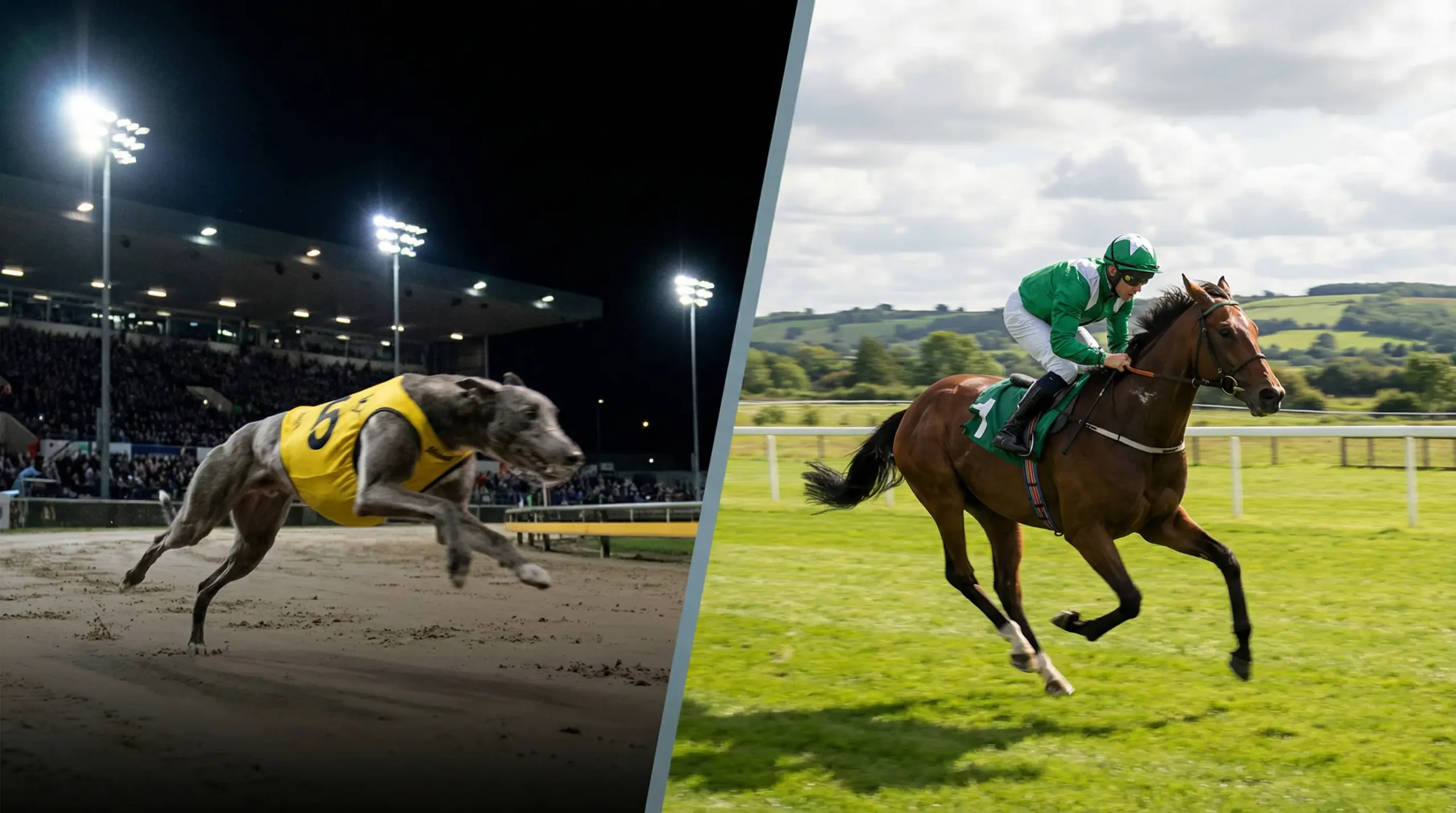
Same Family, Different Animal
Greyhound betting and horse racing betting share a common ancestry — both involve backing an animal to win a race, both use fractional and decimal odds, both offer forecast and each way markets, and both have a long tradition in British betting culture. Many punters who bet on horses assume they can transfer their approach directly to greyhounds without adjustment. Some of it carries over. Much of it does not.
The differences between the two sports are structural, not cosmetic. Field sizes, race duration, market depth, form factors, and the mechanics of odds formation all differ in ways that affect your betting decisions. Understanding where the two sports diverge — and where the skills and instincts developed in one apply to the other — is essential for anyone making the transition between them or betting on both.
Field Size, Race Duration and Market Timing
The most obvious difference is field size. Greyhound races feature six dogs. Horse races regularly feature fields of eight to twenty or more runners. A six-runner field is a fundamentally different betting environment from a sixteen-runner handicap. The probability of any individual dog winning a greyhound race is higher by default — roughly 16.7% in a level field, compared to 6.25% in a sixteen-runner horse race. This affects the odds structure: greyhound markets compress around shorter prices, with favourites typically between even money and 3/1, and outsiders rarely exceeding 10/1. Horse racing markets range from odds-on favourites to 100/1 outsiders.
Race duration is dramatically different. A greyhound race lasts around thirty seconds. A horse race lasts between one and four minutes depending on the distance. The brevity of greyhound racing means there is almost no time for a race to develop tactically — positioning is established in the first five seconds and changes only through interference, bumping, or a dramatic late finish. In horse racing, tactical decisions by jockeys, changes in pace, and positional moves through the field are ongoing throughout the race. This makes greyhound races more predictable in terms of how they unfold from the traps, but more volatile in outcomes because a single incident at the first bend can determine the result.
Market timing is compressed in greyhound racing. Early prices on horse races can be available days in advance for major meetings. Greyhound early prices appear ten to twenty minutes before the off. The window for assessing odds, identifying value, and placing your bet is measured in minutes, not hours. This compressed timeline suits bettors who can make quick decisions based on prepared analysis, but it disadvantages those who prefer to study the market at leisure before committing.
Odds Formation and SP Mechanics
The mechanics of odds formation differ between the two sports in ways that affect the quality of the market signal you are betting into.
Horse racing has deep, liquid markets. Major races attract significant betting volume from both recreational and professional punters, and the odds reflect a broad consensus of informed opinion. The starting price in horse racing is derived from a competitive on-course market with multiple bookmakers and substantial turnover. This makes horse racing SPs relatively efficient — they approximate the true probability of each outcome reasonably well.
Greyhound markets are thinner. On-course betting at greyhound tracks is minimal at most meetings, particularly BAGS fixtures. The SP is derived from a smaller market with less competitive pressure, which means greyhound SPs can be less accurate as a reflection of true probability. Early prices are set by bookmaker algorithms rather than by market interaction, and the overround on greyhound markets is typically wider — 120% to 135% compared to 110% to 120% for major horse races. For bettors, this means less value in the odds on average, but also more opportunity for mispricing because the market has not been tested by the volume of money that flows through horse racing.
Best Odds Guaranteed works the same way in both sports — take the early price, receive SP if it is higher. But the value of BOG is arguably greater in greyhound racing because the late market movements can be more volatile. A horse price might move from 5/1 to 9/2 in the final minutes. A greyhound price can move from 5/1 to 8/1 in the same window because the market is thinner and individual bets have proportionally more impact. BOG captures those wider swings more frequently on greyhounds.
Form Factors: What Carries Over and What Does Not
The discipline of studying form carries over completely. Reading recent results, assessing the quality of competition, tracking weight changes, analysing times — these skills are directly transferable between the two sports. A punter who knows how to read a horse racing form guide already understands the principles of form analysis and can apply them to greyhound race cards with relatively little adjustment.
What does not carry over is the content of the form analysis. In horse racing, the jockey is a major factor — the same horse with different jockeys can produce very different results. In greyhound racing, there is no jockey. The dog runs independently, and the only human influence on race day is the trainer’s preparation leading up to the event. Trainer form replaces jockey form as a secondary analytical factor, but it operates differently — trainer influence is indirect and pre-race, not direct and in-race.
Going and track conditions matter in both sports, but the surfaces are different. Horses run on turf, all-weather, or occasionally fibresand. Greyhounds run exclusively on sand. The range of going descriptions is narrower for greyhounds — you will not encounter the firm, good, soft, heavy spectrum that horse racing uses — but the impact of weather on the sand surface is real and analytically relevant. Horse racing punters who are accustomed to factoring going into their assessments can apply the same instinct to greyhound racing, adjusting for the different surface characteristics.
Trap draw in greyhound racing has no direct equivalent in horse racing. While draw bias exists on certain flat courses — low draws favoured at Chester, high draws at Beverley — the effect in greyhound racing is more consistent and more pronounced. Every greyhound race is affected by trap draw to some degree, and the data is available and reliable. Horse racing punters entering greyhound betting should treat trap draw analysis with the same seriousness they give to course and distance form — it is a primary factor, not a secondary one.
Distance analysis carries over in principle but differs in scale. Horse racing distances range from five furlongs to four miles. Greyhound distances range from roughly 210 metres to 900 metres. The variation is smaller, but the impact of running over the wrong distance is just as significant. A sprinter entered over a staying distance will struggle in both sports. The analytical question — does this animal suit this distance? — is identical.
Two Sports, One Discipline
The punter who succeeds at horse racing and wants to succeed at greyhound racing needs to adjust the content of their analysis, not the discipline behind it. Study form with the same rigour. Assess the market with the same scepticism. Manage your bankroll with the same structure. But learn the specific mechanics of the greyhound game — trap draw, running style, the compressed market window, the six-dog field — and integrate them into your approach rather than assuming that horse racing habits will transfer automatically.
The two sports share enough common ground that experience in one genuinely helps with the other. The analytical framework, the odds literacy, the understanding of value — all of it carries over. What changes is the detail, and in betting, the detail is where the edge lives.
Compare greyhound and horse racing on the livegreyhoundbetting homepage.
Read the full history of UK greyhound racing in greyhound history.
