 Live Greyhound Betting
 UK Greyhound Racing Tracks: Full Guide to Venues & Distances
 Available in US
Complete guide to UK greyhound tracks — layouts, distances, surfaces and key venue differences. Find out how each track shapes race outcomes.
- No Two Tracks Race the Same Way
- How Many Greyhound Tracks Are There in the UK?
- Track Configurations: Circumference, Bends and Surface
- Major UK Tracks: Profiles and Distance Breakdowns
- Greyhound Racing Distances: Sprints, Middle and Stays
- BAGS Meetings, Open Races and Derby Tracks
- Track Knowledge Is Betting Knowledge
No Two Tracks Race the Same Way
A dog that wins at Romford might struggle at Monmore — the track decides. This is one of the first things experienced greyhound punters learn and one of the last things casual bettors figure out. The assumption is that a fast dog is a fast dog, and it’ll perform the same wherever it races. In practice, the track itself is a variable as significant as form, fitness, or trap draw. Ignore it, and you’re betting with incomplete information.
UK greyhound tracks vary in circumference, bend tightness, sand depth, drainage quality, and standard racing distances. A small, tight circuit rewards early-speed dogs that handle sharp bends without losing momentum. A larger, more galloping track suits dogs with stamina and a longer stride. The same dog can look like a champion at one venue and an also-ran at another, purely because the track characteristics don’t suit its running style.
This guide covers the landscape of UK greyhound racing venues as it stands in 2026 — how many tracks are active, what distinguishes them, how distances break down, and why the difference between a BAGS afternoon meeting and a Saturday night open race matters to your betting. If you’ve been treating the track name on the race card as nothing more than a location, this is the section where that habit gets corrected.
How Many Greyhound Tracks Are There in the UK?
As of 2026, the GBGB licenses 18 active stadia across England and Wales (GBGB Racecourses). That number has been declining steadily for decades — there were over seventy licensed tracks in the 1940s — and the contraction continued through 2025, when Crayford closed in January (Crayford Racing), Perry Barr in August (SBC News), and Swindon in December (Racing Post). Dunstall Park, a new venue at Wolverhampton Racecourse, opened on 19 September 2025 as a replacement for Perry Barr (Dunstall Park), but the net direction of travel is downward. Every track closure removes a venue from the circuit and reshuffles the trainer population, the grading system, and the geographic spread of available racing.
The surviving tracks are concentrated in England, spread from Newcastle in the north to Brighton and Hove on the south coast, with a single licensed venue in Wales at Valley Stadium in Ystrad Mynach — though the Welsh Government announced a ban on greyhound racing in February 2025 (GREY2K USA), which puts that track’s long-term future in doubt. There are no GBGB-licensed tracks in Scotland, and Northern Irish greyhound racing operates under the Irish Coursing Club rather than the GBGB (GBGB Licensing).
For bettors, the practical effect of this shrinking map is straightforward: fewer tracks mean more concentrated racing, tighter grading pools, and dogs repeatedly meeting the same rivals. That can make form study more reliable at certain venues — you see the same dogs racing week after week, and patterns emerge. But it also means that when a dog switches to an unfamiliar track, the form translation becomes less certain, because the track itself is an unfamiliar variable.
The 18 licensed stadia as of early 2026 include Towcester, Nottingham, Monmore (Wolverhampton), Romford, Hove, Sheffield, Newcastle, Oxford, Yarmouth, Kinsley, Doncaster, Central Park (Sittingbourne), Star Pelaw (formerly Pelaw Grange), Sunderland, Dunstall Park, Valley (Wales), Harlow and Mildenhall (GBGB Racecourses). The exact list can shift — tracks have opened and closed with surprising regularity in recent years — so checking the GBGB’s official racecourse page for the current status is worth doing before committing to form study on any venue.
Track Configurations: Circumference, Bends and Surface
All UK tracks use sand surfaces — but the circumference varies from roughly 261 metres at the smallest circuits to over 500 metres at the largest. That range is enormous relative to the length of a greyhound race, and it changes everything about how a race is run: the speed through the bends, the advantage of inside traps, the importance of early pace, and the types of dogs that thrive.
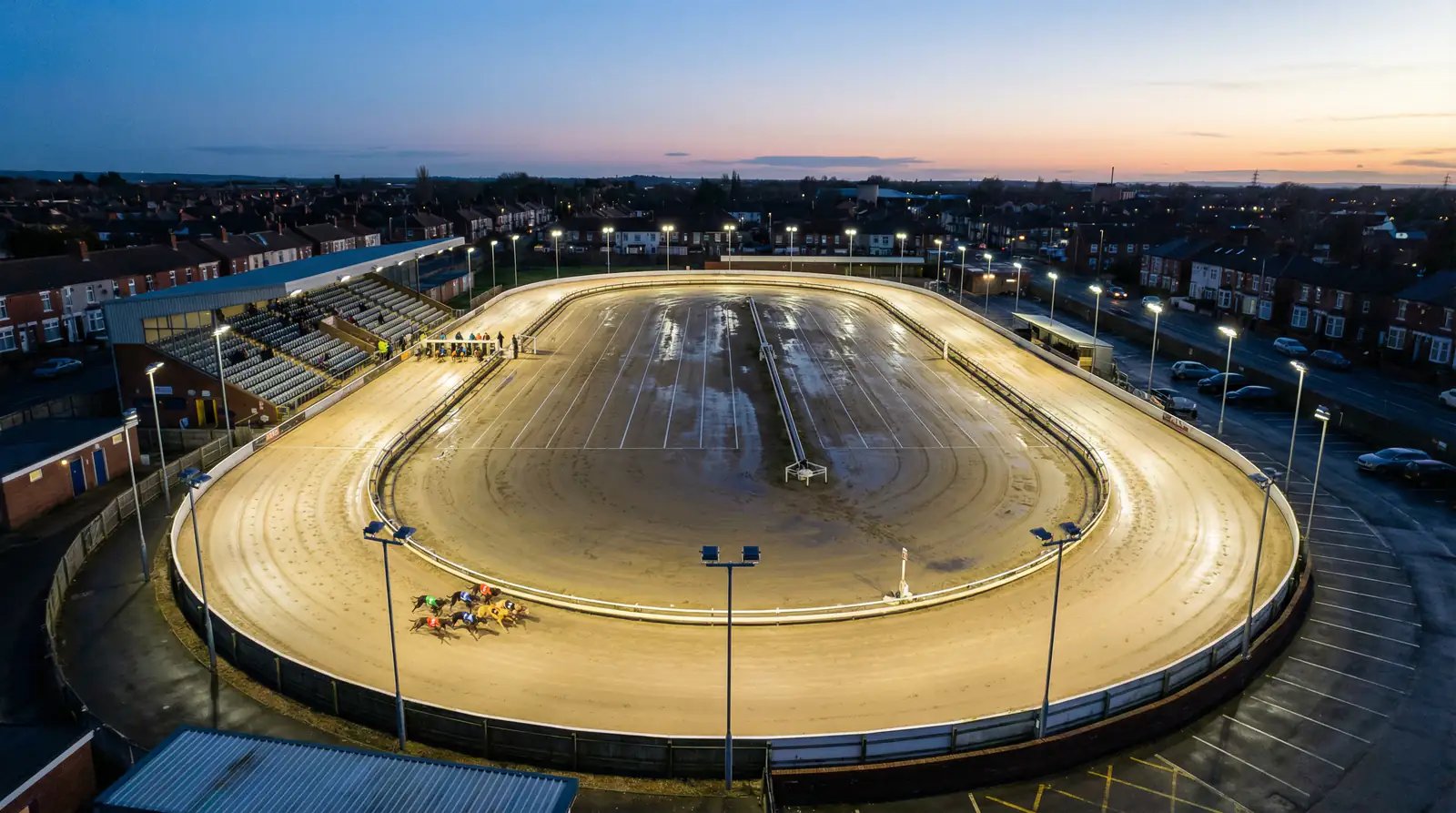
Every GBGB-licensed track is an oval with four bends and two straights, though the proportions vary significantly. A small-circumference track packs those four bends into a tighter space, meaning the bends are sharper and the straights shorter. A large-circumference track spreads them out, giving dogs more room to run through the turns and longer straights on which to build or maintain speed. The mechanical lure — the artificial hare that the dogs chase — runs on a rail around the outside of the track, and its speed is controlled by the hare driver to stay ahead of the leading dog.
The running surface at all licensed venues is sand, but the sand composition and depth differ from track to track. Some venues use finer, denser sand that produces a firmer running surface. Others use coarser, deeper sand that gives more cushion but slows the dogs down marginally. The sand is maintained by track staff, watered before racing, and harrowed between races to keep the surface consistent. Despite these efforts, conditions can vary during a meeting — the sand dries out under warm conditions, firms up in cold weather, and becomes heavier after sustained rain.
The starting traps are positioned on one of the straights, and the distance from the traps to the first bend is a critical variable. A short run to the first bend compresses the early stages of the race, forcing dogs into tighter competition for position before they’ve fully hit their stride. A longer run to the first bend allows more separation before the crowding at the turn, which tends to produce cleaner racing and fewer interference issues. When assessing trap draw advantage at any given track, this run-in distance is one of the first things to consider.
Track Size and How It Affects Running
Tighter tracks favour early-speed dogs that handle the bends. This is the single most important principle of track analysis, and it holds true across virtually every venue in the country. On a small circuit with sharp bends, a dog that breaks fast from the traps, secures a rail position, and maintains speed through the turns has a decisive structural advantage. The bends are where races are won and lost at tight tracks — a dog that loses ground through the turns rarely makes it up on the short straights.
At larger tracks, the equation shifts. The sweeping bends penalise wide runners less, and the longer straights give closers — dogs that run on strongly in the final straight — a genuine chance to overhaul front-runners. Dogs with stamina and a longer stride pattern are more competitive at galloping tracks, even if they’re not the quickest out of the traps. The bend speed that dominates at Romford is less decisive at a venue like Towcester, where the 420-metre circumference gives dogs more room to race.
The betting implication is direct: a dog’s form at one track type doesn’t automatically transfer to another. If you’re following a dog that has been winning consistently at a tight circuit, and it’s entered at a larger venue for an open race, its form needs discounting. The reverse applies too — a dog that looks moderate at a galloping track might be ideally suited to a switch to a tighter venue where its early pace becomes more valuable. Track-aware punters look for these mismatches because the market often doesn’t price them correctly.
Sand Composition, Drainage and Weather Impact
Heavy rain on a sandy track slows times — and that changes the race. The sand surface at UK greyhound tracks is more sensitive to weather conditions than many bettors appreciate. A dry, firm surface produces faster times and tends to favour lighter, quicker dogs. A wet, heavy surface slows the going, increases the physical demands, and can shift the advantage towards stronger, heavier dogs with more power through their stride.
Drainage is a factor that varies between venues. Some tracks drain quickly after rain, returning to near-normal conditions within a race or two. Others hold moisture for longer, meaning the early races on a rain-affected card might run on significantly heavier ground than the later ones. If you’re betting on the seventh race at a track that received heavy rain before the first, checking the times from earlier races gives you a real-time gauge of whether the surface has recovered.
Temperature matters too, though less dramatically than rainfall. Cold conditions can firm up the sand surface, producing quicker times. Very warm weather can dry the surface out excessively between waterings, creating an inconsistent running strip. Track staff manage these variables as best they can, but they can’t eliminate them — and the dogs are the ones running on the surface, not the staff. A dog that has shown its best form on firm, dry sand is a different proposition on a rain-softened track, and vice versa. It’s a data point that takes thirty seconds to check and can save you from backing a dog on unsuitable going.
Major UK Tracks: Profiles and Distance Breakdowns
Let’s walk through the tracks that host the highest-profile racing. Not every GBGB-licensed venue carries the same weight in terms of quality and prestige. Some tracks host Category One open races, the English Greyhound Derby, and attract the best dogs from the top kennels. Others are primarily BAGS venues running afternoon and evening graded cards for the betting market. Both types matter to punters, but for different reasons — the prestige tracks define the sport’s competitive peak, while the BAGS tracks provide the day-in, day-out betting opportunities that most punters interact with.
The profiles below focus on the venues that combine high-quality racing with distinctive track characteristics that meaningfully affect betting outcomes. Each track has its own personality, and learning that personality is part of the job.
Nottingham, Towcester and Monmore
Nottingham is one of the UK’s most prestigious greyhound venues, regularly hosting Category One competitions. The standard sprint distance is 305 metres, with middle-distance races at 500 metres and longer trips available. The track has a circumference of around 400 metres with reasonably sweeping bends, making it a fairer circuit than some of the tighter venues. Trap bias at Nottingham is moderate — inside traps carry a slight advantage at sprint distances, but the bends are open enough that wide runners are not hopelessly disadvantaged. Nottingham’s graded racing draws from a strong local trainer base, and the quality of the resident greyhound population is consistently high.
Towcester has established itself as the home of the English Greyhound Derby — the sport’s most prestigious single event (GBGB). The track was built inside the Towcester horse racecourse and opened on 6 December 2014, giving it a large circumference of approximately 420 metres with wide, sweeping bends. The distances are 260, 480, 500, 655, 686, and 906 metres, giving it one of the broadest distance ranges of any UK venue. Towcester’s wide bends suit galloping dogs and make it a relatively fair track from a trap draw perspective. The sand surface is well-maintained but the track’s exposed location in the Northamptonshire countryside means it can be affected by weather more than urban venues. Under new management from late 2025, Towcester races on Saturday evenings and Sundays, and its open race programme is among the strongest in the country.
Monmore Green in Wolverhampton is a tight, fast circuit that produces some of the most competitive graded racing in the Midlands. The circumference is roughly 280 metres, making it one of the smaller tracks on the circuit. The tight bends mean early pace is at a premium here — dogs that can secure a rail position out of the traps have a significant advantage, and the inside traps historically outperform the outside. Monmore hosts Category One events including the Ladbrokes Winter Derby and regularly features on the BAGS afternoon schedule. The track’s compactness makes it a specialist venue: dogs that handle Monmore’s bends tend to thrive there repeatedly, while those that need room to run often find it frustrating. For bettors, Monmore track form is some of the most reliable in the country — if a dog has proven it can win there, it’s likely to do so again.
Romford, Hove and Sheffield
Romford is tight, fast and favours railers from low traps. It is one of the most distinctive venues in the country and one of the most polarising among form students. The circumference is around 275 metres with sharp bends that punish wide runners severely. Inside traps — particularly Trap 1 — have a statistically significant advantage at sprint distances, and dogs drawn in Trap 5 or 6 need either exceptional early pace or a degree of luck to overcome the geometric disadvantage. Romford hosts Category One events including the Coral Essex Vase and Coral Golden Sprint, and it’s a frequent BAGS venue. If you’re betting on Romford regularly, understanding the trap bias is not optional — it’s the foundation of every selection.
Brighton and Hove sits on the south coast and runs a regular BAGS programme alongside its open race schedule. The circumference is moderate, and the bends are less severe than Romford or Monmore, making it a more balanced venue for different running styles. Hove hosts the Coral Sussex Cup and has a strong tradition of producing quality sprinters. The standard distances include 285 metres for sprints, 500 and 515 metres for middle-distance races, 695 metres for staying races, and marathon trips up to 970 metres. Hove’s south-coast location means it can be affected by coastal wind conditions, which is a minor but occasionally relevant factor for times and running patterns.
Sheffield, at Owlerton Stadium, is a large-circumference track in the north of England with sweeping bends that suit galloping, stamina-tested dogs. The standard distances are 280 metres (sprint), 480 metres (standard) and 660 metres (staying), and the track regularly hosts Category One competitions including the Steel City Cup. Sheffield’s wide bends reduce the inside trap advantage compared to tighter venues, and dogs with a strong finish are more competitive here than at circuits where the bends compress the field. For bettors, Sheffield rewards a different kind of form assessment — early pace matters less, and sustained running ability matters more.
Greyhound Racing Distances: Sprints, Middle and Stays
UK races cover three bands: sprint, standard and staying. The exact distances vary by track — each venue sets its own race distances based on the positioning of starting traps around the circuit — but the categories are consistent across the sport and carry distinct characteristics that affect both the racing and the betting.
Sprint races cover distances under approximately 300 metres, with most tracks offering sprints in the 260 to 305 metre range. These are the shortest greyhound races, typically completed in around 16 to 17 seconds, and they’re overwhelmingly about early pace. The dog that breaks fastest and reaches the first bend in front usually wins, because there isn’t enough distance for a slower starter to recover. Sprint races amplify the trap draw advantage at tight tracks, reduce the relevance of stamina, and tend to produce shorter-priced favourites because the element of randomness is compressed. For bettors, sprints are the format where trap position and early sectional times matter most.
Standard races — the most common distance in UK greyhound racing — sit in the 400 to 500 metre range. These races require dogs to negotiate three or four bends and cover enough ground that stamina, race fitness, and the ability to sustain pace all become factors alongside early speed. Standard-distance races are where the full range of running styles comes into play: front-runners, mid-pack chasers, and closers all have chances depending on how the race unfolds. Most graded racing and the majority of BAGS fixtures use standard distances, making them the bread and butter of day-to-day greyhound betting.
Staying races cover distances above approximately 600 metres, with some tracks offering marathon trips of 700 metres or more. The Cesarewitch at Central Park, for instance, is run over 731 metres (Central Park). Staying races are less common than sprints or standard trips, and they attract a specialist subset of dogs — slower out of the traps, often larger and heavier, but with the stamina to maintain their pace over multiple circuits of the track. Staying races produce wider-priced results on average because the longer distance introduces more opportunities for interference, position changes, and shifts in momentum. For bettors who specialise in this distance, the lack of mainstream attention means the markets can be less efficient, which is where opportunities live.
One note on distance and track interaction: the same nominal distance plays differently at different tracks. A 480-metre race at a tight venue involves sharper bends and a different balance of pace and stamina than a 480-metre race at a galloping track. Always consider the track characteristics alongside the distance — they’re not independent variables.
BAGS Meetings, Open Races and Derby Tracks
Most bettors interact with BAGS fixtures — midweek afternoon cards that form the backbone of the UK greyhound betting calendar. BAGS, the Bookmakers’ Afternoon Greyhound Service, is a fixture system funded by contributions from licensed bookmakers. It provides a scheduled programme of greyhound racing throughout the week, typically running from late morning through to early evening, giving bookmakers a live product to offer and punters a steady supply of races to bet on.
BAGS meetings are overwhelmingly graded races — dogs slotted into races by the track’s racing manager based on their recent form, times, and class level. The grading system ensures competitive fields, but it also means that BAGS racing operates at a different intensity to open-race nights. The prize money is lower, the profile is lower, and the quality of the fields is generally — though not always — below the standard of a Saturday night open race card. None of that makes BAGS meetings less valuable for betting; it just means the dynamics are different. Form tends to be more predictable at BAGS meetings because the grading process groups dogs of similar ability together, which compresses the field and makes outcomes more dependent on trap draw, pace, and current form than on raw class.
Open races sit at the top of the competitive hierarchy. These are Category One and Category Two events organised by the GBGB, open to entries from kennels across the country rather than restricted to a track’s resident dogs. The English Greyhound Derby at Towcester (GBGB), the St Leger at Nottingham, the Cesarewitch at Central Park, and a host of other named competitions attract the best dogs in training and offer the highest prize money. Open races are where class differences become most visible — a top-grade dog racing in an open event is a genuine athlete, and the standard is measurably higher than weekday graded racing.
For bettors, open races present a different challenge. The fields are stronger and more competitive, the form lines are harder to assess because dogs may be arriving from different tracks with different grading systems, and the market is more closely scrutinised by professional punters and bookmaker traders. But open races also offer more substantial betting markets, deeper liquidity, and the kind of high-profile racing that draws media coverage and extended form analysis from data providers. If you’re serious about greyhound betting, developing a strategy for open-race weekends — alongside your BAGS fixture approach — is essential.
Track Knowledge Is Betting Knowledge
Know the track before you know the dog — that’s the order. It runs counter to how most punters work, which is to find a dog they fancy and then check where it’s racing. But the track shapes the race before any individual dog sets foot on the sand. The circumference decides how tight the bends are. The bend tightness decides how important early pace is. The distance decides whether stamina matters or doesn’t. The surface conditions decide how fast times will be. All of that information is available before you open the race card.
Building a working knowledge of even four or five tracks — the venues you bet on most regularly — gives you an analytical layer that most punters simply don’t have. You’ll know which traps carry a bias. You’ll know whether the track suits front-runners or closers. You’ll know when a dog switching from a tight circuit to a galloping one is likely to struggle, even if its form figures look impressive. That knowledge compounds over time, race by race, and it’s the kind of edge that doesn’t rely on luck, tipsters, or inside information. It relies on homework, and the track is where the homework starts.
Explore all UK greyhound racing tracks on the livegreyhoundbetting homepage.
See how track conditions affect results in track conditions.
