 Live Greyhound Betting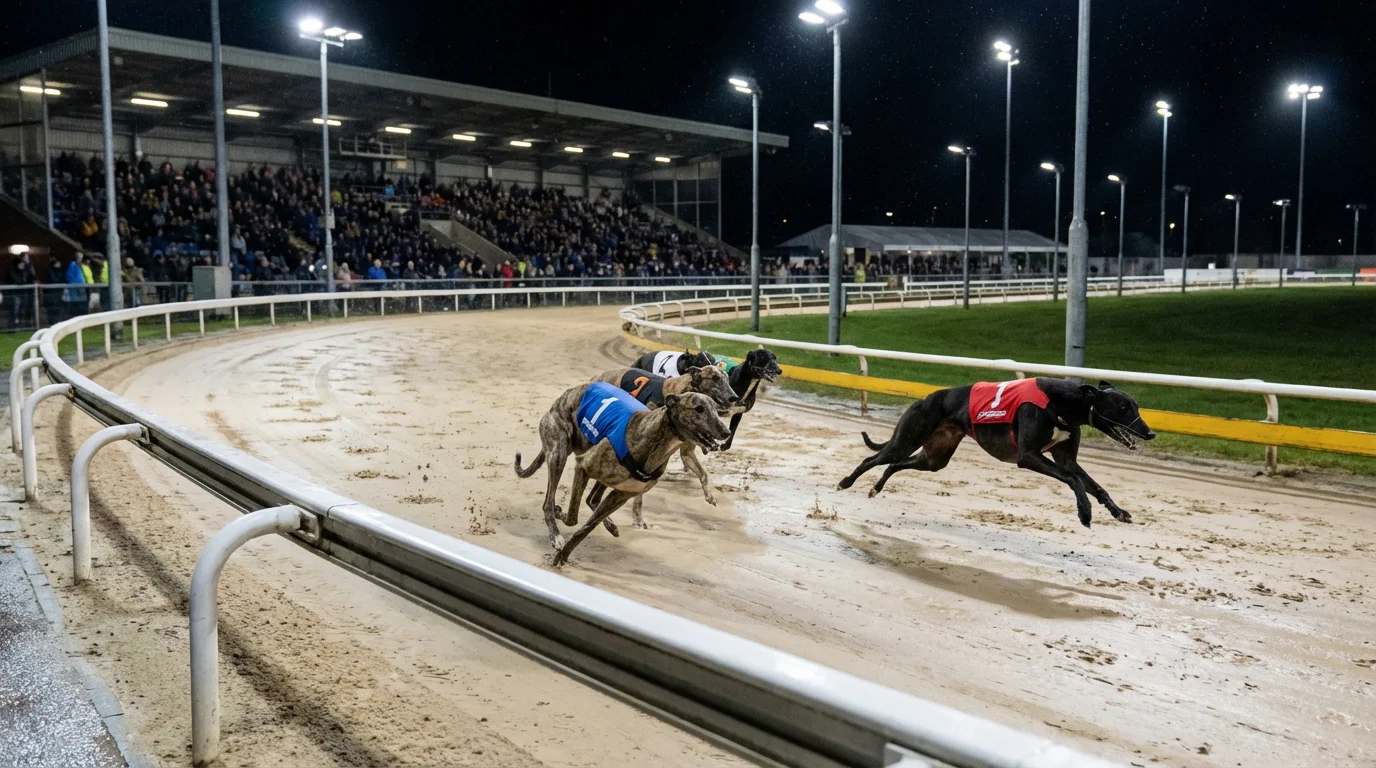
Best Greyhound Betting Sites – Bet on Greyhounds in 2026
Loading...
Every Dog Runs Its Own Race
Running style is a greyhound’s signature. Some dogs explode from the traps and lead from the first bend to the line. Others settle behind the pace and produce a finishing burst through the final straight. Some hug the inside rail as if magnetised to it. Others swing wide through every bend, covering extra ground but avoiding the traffic that builds on the inside. These tendencies are not random — they are consistent behavioural patterns that repeat across race after race, and they are among the most reliable predictors of how a dog will perform under specific conditions.
For bettors, running style is the bridge between raw form data and a practical understanding of how a race will unfold. Two dogs might have identical recent form figures, but if one is a front-running railer and the other is a wide-running closer, they will experience the same race in completely different ways. The front-runner needs a clean break and an inside draw. The closer needs a contested early pace and space on the outside. Understanding these dynamics allows you to assess not just which dogs are fastest, but which dogs are most likely to get the run they need to show that speed.
This guide breaks down the main running style categories, explains how lateral movement — railing versus running wide — affects a dog’s chances, and shows how to match running style to trap draw for sharper selections.
Front Runners, Mid-Pack Dogs and Closers
The most fundamental classification of running style is based on where a dog positions itself in the early stages of a race. Front runners, mid-pack dogs, and closers represent three distinct approaches to the sprint, each with its own advantages and vulnerabilities.
Front runners are dogs that break sharply from the traps and aim to lead the field into the first bend. Their sectional times typically show a fast first-bend split relative to the rest of the field. The advantage of front-running is clear: the dog that leads has the cleanest passage. It avoids the bumping and checking that occurs behind it, it chooses its own racing line, and it sets the pace for the rest of the field. In greyhound racing, where races last under thirty seconds and overtaking opportunities are limited, leading from the front is the most direct path to victory. Statistically, the dog that leads at the first bend wins the race more often than any other positional group.
The vulnerability of front-runners lies in contested leads. When two or three dogs have similar early pace and are drawn in adjacent traps, they converge on the first bend simultaneously. The resulting crowding can check all of them, allowing a dog further back to inherit the lead or find clear ground on the outside. A front-runner that gets a clean break is dangerous. A front-runner that gets tangled up at the first bend is often finished — its style depends on uninterrupted momentum, and once that momentum is disrupted, it rarely recovers in a race this short.
Mid-pack dogs occupy the middle ground. They do not have the explosive early speed to lead, but they have enough pace to stay in contention through the first two bends. Their chances depend on the race shape — if the early pace is strong and the leaders tire, a well-placed mid-pack runner can close the gap through the final bends. If the early pace is slow and the leader has an easy time at the front, the mid-pack dog may never get close enough to challenge. These dogs are the hardest to assess because their performance is the most dependent on how the rest of the field runs.
Closers are dogs that start slowly, settle at the back of the field through the early stages, and produce their best speed in the final two bends and the home straight. Their run-home split times are typically the fastest in the field, but their first-bend times are among the slowest. Closers win by picking off tiring leaders and navigating past mid-pack dogs that are losing momentum. They are most effective in races with a fast, contested early pace — when three or four dogs burn energy fighting for the lead, the closer arrives late with fresh reserves and exploits the fatigue ahead of it.
The weakness of closers is that they need the race to unfold a certain way. If a single front-runner leads unchallenged and conserves energy, it may hold on to the finish and the closer never gets close enough. In greyhound racing, where the total distance is short and the margins are tight, a closer needs a lot to go right — a fast early pace, minimal interference in the second half of the race, and enough room to pass. When those conditions align, closers can produce spectacular finishes. When they do not, the closer finishes third or fourth despite having the strongest finishing speed in the field.
Railers vs Wide Runners
Lateral running preference — whether a dog stays on the rail or swings wide through the bends — is the second axis of running style analysis. It operates independently of pace profile: a dog can be a front-running railer, a front-running wide runner, a closing railer, or a closing wide runner. The combination of pace profile and lateral preference defines the dog’s complete running style.
Railers are dogs that naturally track the inside rail through the bends. They cover the shortest distance around the oval, which is a geometric advantage worth several lengths over a four-bend race. Racing managers typically assign railers to inside traps — trap 1 and trap 2 — where they have immediate access to the rail. A railer drawn in trap 1 on a tight track has two converging advantages: the shortest route and the closest starting position to that route. This is the most favourable configuration in greyhound racing and produces winners at a higher rate than any other style-draw combination.
The limitation of railers is their dependence on the inside being clear. If another dog cuts across from a higher trap and occupies the rail first, the railer can be forced to check, lose momentum, or run wider than its preference. In a field with two strong railers drawn in traps 1 and 2, they may crowd each other through the first bend, negating the rail advantage for both. Railers are at their most effective when they have uncontested access to the inside line — which is why trap draw is so critical for dogs with this style.
Wide runners take the opposite approach, swinging through the bends on the outside of the field. They cover more ground, but they avoid the congestion that builds on the inside. On larger tracks with sweeping bends, the penalty for running wide is smaller, and wide runners can be genuinely competitive despite the extra distance. On tight tracks with sharp bends, the ground lost by running wide is more severe, and wide runners face a significant geometric disadvantage.
Wide runners are often drawn in traps 5 and 6, where their natural tendency to run outside is supported by their starting position. A wide runner drawn in trap 1 faces a conflict — it starts on the inside but wants to run outside, and the act of drifting wide from a low trap can cause interference with the dogs drawn beside it. Conversely, a wide runner drawn in trap 6 can swing wide from the start without disrupting anyone, find clear ground, and run its preferred race shape.
Matching Running Style to Trap Draw
The interaction between running style and trap draw is where form analysis becomes genuinely predictive. A dog’s form figures tell you what it has done. Its running style tells you how it did it. The trap draw tells you whether today’s conditions allow it to do it again.
The ideal configuration is a front-running railer in trap 1 or trap 2 on a track with a strong inside-trap bias and a short run to the first bend. This dog has every factor working in its favour — early speed puts it in front, its railing instinct keeps it on the shortest route, and the low trap gives it immediate rail access without needing to cross the field. When you identify this configuration in a race, the dog deserves serious consideration regardless of its price.
The worst configuration is a closer drawn in trap 3 or trap 4 on a tight track with a dominant front-runner in trap 1. The closer has no pace advantage, no positional advantage, and is likely to encounter traffic through the middle of the field while the front-runner builds an unassailable lead on the rail. Middle traps are the most problematic for dogs with pronounced running styles because they offer neither the rail nor the wide ground — the dog is forced to react to the runners around it rather than executing its preferred pattern.
When studying a race card, map each dog’s running style against its trap draw before anything else. Ask three questions for each runner. Does this dog’s style match its trap? Does the track configuration suit that style? And is there another dog in the field whose style and draw create a conflict that might disrupt the race shape? A front-running railer in trap 1 with no early-pace competition from traps 2 and 3 is in an ideal position. The same dog in trap 1 with two other front-runners beside it in traps 2 and 3 faces a crowded first bend and a much less certain outcome.
Style-draw analysis does not replace form study — it refines it. A dog with strong recent form but a poor style-draw match today is a riskier selection than its form alone suggests. A dog with moderate form but a perfect style-draw alignment might outrun its recent record. The bettors who consistently integrate running style into their assessment process find value that the market, which tends to weight recent finishing positions most heavily, does not fully price in.
The Dog Runs the Way It Runs — Your Job Is to Know When That Works
Running style is one of the most stable attributes of a greyhound’s profile. A railer does not become a wide runner overnight. A front-runner does not suddenly develop the patience to close from the back of the field. These tendencies are ingrained, and while minor variations occur from race to race, the broad pattern holds across a dog’s career.
That stability is what makes running style so analytically useful. You can predict, with reasonable confidence, how a dog will approach its race. The question is whether the race — the trap, the track, the field composition — allows that approach to succeed. When it does, style becomes an edge. When it does not, style becomes a constraint. Knowing the difference is one of the quieter skills in greyhound betting, and one of the most valuable.