 Live Greyhound Betting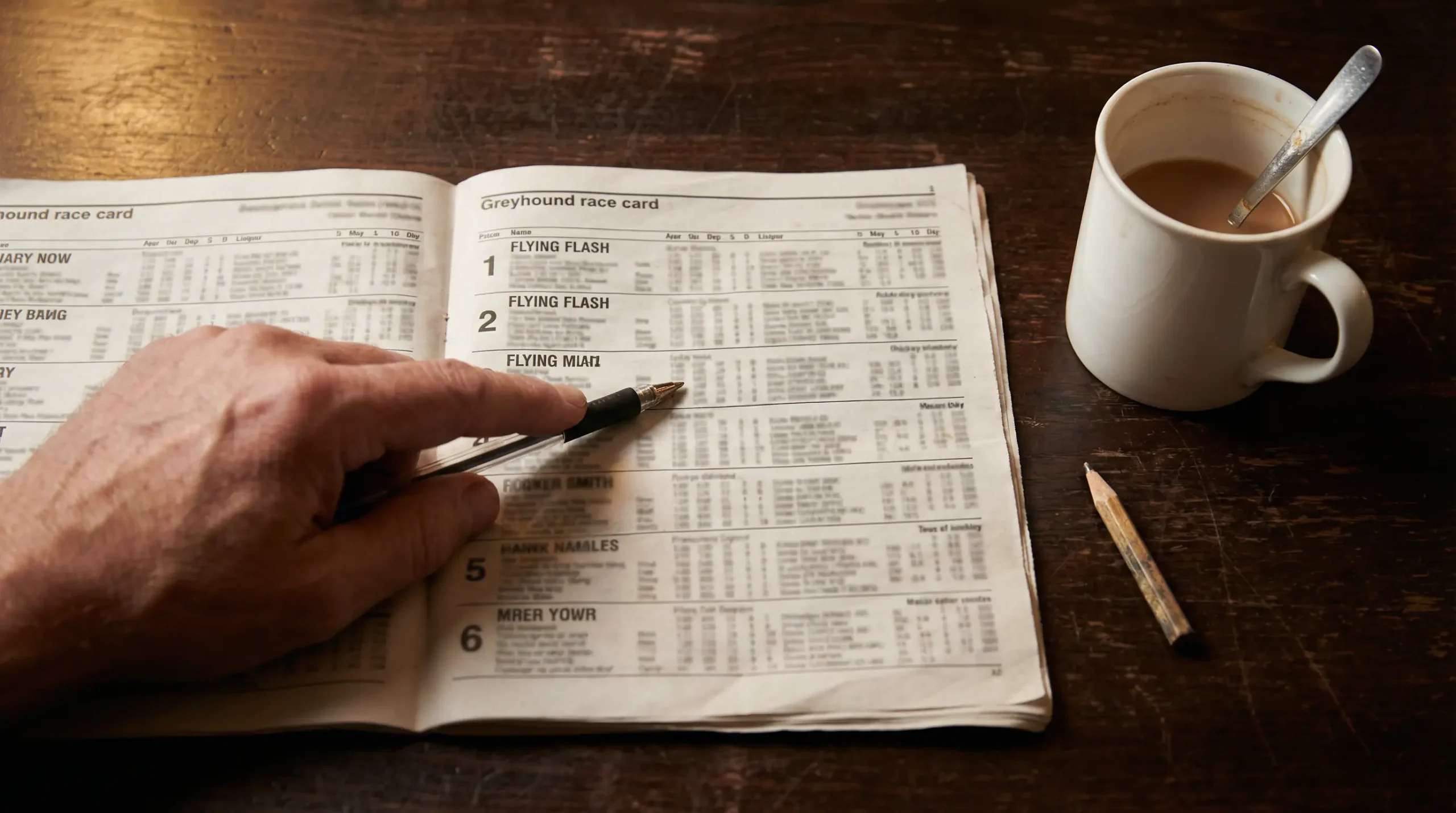
Best Greyhound Betting Sites – Bet on Greyhounds in 2026
Loading...
- The Race Card Is Not Decoration — It's Your Edge
- Layout of a Standard Greyhound Race Card
- Form Figures: Recent Results Decoded
- Trap Draw and Its Effect on Race Outcome
- Weight, Sectional Times and Calculated Times
- Trainer and Kennel Information
- Putting It All Together: Building a Pre-Race Assessment
- Numbers Don't Lie — But They Don't Tell the Whole Story
The Race Card Is Not Decoration — It’s Your Edge
Everything you need to know about a greyhound race is already written down. It’s sitting in the race card — a compact grid of numbers, letters, abbreviations and symbols that most punters glance at for three seconds before picking the dog with the best name. That approach has roughly the same analytical rigour as throwing darts at the programme. The race card exists to make it unnecessary.
A greyhound race card is a compressed data sheet. It tells you where each dog is drawn, how it has performed recently, how fast it runs, how much it weighs, who trains it, and what happened in its last six outings. All of that information is available before the traps open, free of charge, from every bookmaker and racing data provider in the country. The problem isn’t access — it’s interpretation.
Reading a race card is a skill, not a talent. It can be learned, practised, and refined. The punter who spends ten minutes studying the card before a race will, over any meaningful sample size, outperform the punter who bets on instinct. That’s not a guarantee of profit — greyhound racing is still a sport where a dog can stumble out of the traps or get bumped at the first bend — but it is a guarantee of better decision-making. And better decisions, compounded over hundreds of races, are the only sustainable edge a bettor has.
This guide takes you through every element of a standard UK greyhound race card. Not a quick overview with one sentence per data point, but a genuine breakdown of what each column means, how to read it, and — critically — how to weigh it against the other information available. By the end, you should be able to look at a race card and build a preliminary assessment of the race before you check a single tipster or odds board.
Layout of a Standard Greyhound Race Card
The card reads left to right: trap, dog name, form, trainer, weight, time. That’s the broad architecture, though the exact column order varies slightly between data providers. Racing Post, Timeform, and the cards displayed by individual bookmakers all present the same core information in marginally different layouts — but the data itself is consistent because it all comes from the same source: the Greyhound Board of Great Britain’s official race records (gbgb.org.uk).
Every dog in the race occupies one row. The row begins with the trap number — 1 through 6, corresponding to the starting position on the inside rail (Trap 1) through to the outside (Trap 6). The trap number is colour-coded on most cards and at the track itself: red for 1, blue for 2, white for 3, black for 4, orange for 5, and black-and-white stripes for 6. These colours match the racing jackets the dogs wear, so they’re useful for identifying runners on a live stream.
Next comes the dog’s name and, usually, its parentage (sire and dam) below in smaller text. Parentage matters to serious form students because certain bloodlines produce dogs with specific running styles — early pace, stamina over longer trips, a tendency to rail or run wide. For most bettors, the name is the identifier and the breeding is background context.
The form column follows. This is the most data-dense part of the card and we’ll spend an entire section on it shortly. In brief: it shows the dog’s finishing positions in its most recent races, typically the last six, with the most recent result on the right. A line reading “3 1 1 2 4 1” tells you the dog finished third six runs back, won the next two, finished second, then fourth, then won most recently.
After form, you’ll see the trainer’s name, the dog’s weight (in kilograms, recorded at the weigh-in before the race), and the time or times from recent races. Some cards also display the dog’s starting price, the race grade, the distance, and notes like days since last run or early pace ratings. The depth of supplementary information depends on the provider — Timeform cards, for instance, include calculated times and pace assessments that the basic bookmaker card does not.
The key habit is reading each row as a complete unit, not cherry-picking one data point. A fast recent time means something different if the dog’s weight has shifted by a kilogram since that run. A string of wins means something different if they came at a lower grade than today’s race. The card gives you the raw material — your job is to connect the dots.
Form Figures: Recent Results Decoded
A row of 111 is simple. A sequence of 433 needs context. Form figures are the headline data on any greyhound race card, and they’re simultaneously the most looked-at and most misunderstood element. Punters see a string of low numbers and assume quality. They see high numbers and assume the dog is no good. Both assumptions miss the point.
Form figures in greyhound racing record finishing positions, not performance levels. A dog that finishes first in an A10 race at a Monday afternoon BAGS meeting is not necessarily better than a dog that finishes fourth in an A1 open race at Nottingham on a Saturday night. The number tells you where the dog finished. It doesn’t tell you who it was racing against, what happened during the run, or whether the performance was better than the result suggests.
This is where reading form becomes an analytical exercise rather than a visual scan. You need to place each finishing position in context. What grade was the race? What track and distance? Was the dog drawn inside or outside? Did it get a clear run or was there trouble at the bends? Some of this information is available directly on the card (grade, track, trap draw), while some requires consulting the detailed race comments available from providers like Timeform or Racing Post.
The direction of form also matters more than the absolute positions. A dog whose recent form reads 5 4 3 2 is improving. A dog showing 1 1 2 3 4 is declining. The improving dog might be the better bet today even though its average finishing position is worse, because the trend suggests it’s coming into peak form or has recently been moved to a more suitable grade or distance. The declining dog, by contrast, may have peaked and is now being caught by the opposition or is carrying an issue the trainer is working through.
What the Numbers Mean
Each digit is a finishing position from the last six races. The sequence reads chronologically from left to right, with the oldest result on the left and the most recent on the right. So a form line of 3 1 2 5 1 1 means: three starts ago the dog finished fifth, then won, and has won its last two. The two earliest results (third and first, reading from left) are the oldest in the sequence.
Numbers run from 1 to 6 in a standard six-runner race. A “1” means the dog won. A “6” means it finished last. In races with fewer runners — five, after a withdrawal with no reserve — the maximum figure is 5. When consulting form, note whether any of the recorded runs were in short-field races, because finishing third of five is a meaningfully different result from finishing third of six.
The form line updates after every race. Once a dog runs a seventh time, the oldest result drops off the left side, and the new result is added on the right. This rolling six-race window means that a dog’s visible form can change character quickly. Two bad runs can transform a “1 1 1 2 1” form line into “1 2 1 4 5” within a fortnight, making the dog look weaker on a casual glance than its overall record deserves. Conversely, a dog can look better than it is if its recent runs have come against poor opposition.
One thing the numbers don’t capture is the margin of victory or defeat. A dog that wins by eight lengths in an A5 race is performing very differently from one that scrapes home by a head in the same grade. The form figure says “1” for both. To get the full picture, you need the detailed race result — the winning distance, the running comments, and the sectional times. The form figure is the starting point of your analysis, not the conclusion.
Reading Between the Lines: Letters and Symbols
An “R” means a reserve run. A “-” means a gap in the schedule. Alongside the finishing position numbers, greyhound form figures contain letters and symbols that carry specific meanings. Miss them, and you’re working with an incomplete picture.
The most common letters you’ll encounter are: “R” for a reserve run (the dog was a substitute for a withdrawn runner and had no allocated trap — reserve runs are worth less as form evidence because the dog was typically drawn in an unfamiliar position); “T” for a trial run, which is not a competitive race and therefore tells you nothing about current ability relative to opposition; and “O” or “0” for a run where the dog didn’t finish or was disqualified.
A dash (“-“) in the form line indicates a break in racing. The dog didn’t run during that period, either due to injury, rest, a change of kennel, or a season (for bitches). A single dash might mean a two-week gap. Multiple dashes mean an extended absence. Dogs returning from a layoff are inherently less predictable — they might come back sharper than ever, or they might need a run or two to regain race fitness. A returning dog’s first run back should be treated as a data-gathering exercise rather than a strong betting proposition, unless you have specific insider knowledge about the reason for the break and the dog’s condition.
Some cards also include small superscript letters or symbols indicating wide running (“w”), bumped or checked (“ck”), led early (“Ld”), or stumbled at the start (“SS”). These vary by data provider and are not universally standardised, but they add valuable context to the bare finishing position. A dog that finished fourth after being badly bumped at the first bend might have been the best dog in the race. Without that annotation, you’d only see “4” and draw the wrong conclusion.
Get into the habit of reading these symbols with the same attention you give the numbers. A form line of “1 1 R3 – 2 1” tells a richer story than it first appears: two wins, a reserve run in third (possibly uncomfortable from an unfamiliar trap), a break from racing, a solid second on return, and a win most recently. That’s a dog returning to form after a layoff and now performing well in its preferred setup. The raw sequence “113-21” barely scratches the surface.
Trap Draw and Its Effect on Race Outcome
Trap 1 is not always an advantage — it depends on the track geometry. This is one of the most persistent misconceptions in greyhound betting: the belief that inside traps are universally better. At some tracks, they are. At others, the outside draw offers a cleaner run into the first bend. And at a few circuits, the middle traps (3 and 4) produce the highest win percentages. The answer is always track-specific, and the data is readily available.
The trap draw tells you where the dog starts relative to the inside rail. Trap 1 is closest to the rail, Trap 6 is furthest out. At a tight, small-circumference track with sharp bends — Romford is the classic example — the inside draw provides a significant advantage because dogs in lower traps can hug the rail and cover less ground through the bends. At larger, more galloping tracks with sweeping bends, the outside draw is less of a disadvantage because there’s more room to manoeuvre and the bends are less punishing on wide runners.
What the race card tells you is which trap each dog is drawn in today. What it doesn’t tell you directly — though you can work it out — is how that dog has performed from this trap number historically. A dog with form figures of 1 1 1 from Trap 2 might look like a machine. But if today it’s drawn in Trap 5, at a track where Trap 5 has a significantly lower win rate, those historic wins are less predictive than they appear.
The sharper approach is to cross-reference the dog’s trap draw with its running style. A dog that shows early pace and tends to rail (run close to the inside) will benefit more from a low trap number. A dog that tends to run wide or needs room to find its stride is less penalised by a high trap draw. When you see a railer drawn in Trap 6, or a wide runner drawn in Trap 1 at a track with tight first bends, that’s a red flag — the trap draw is working against the dog’s natural running pattern.
Track-specific trap statistics are published by most serious greyhound data providers. These show the historical win percentage for each trap position at each track, sometimes broken down by distance and race grade. Over thousands of races, clear patterns emerge. At Monmore, for instance, the bias may favour different traps than at Sheffield. Learn the numbers for the tracks you bet on most frequently, and treat the trap draw as one of the first things you check when assessing a race.
Weight, Sectional Times and Calculated Times
A greyhound’s weight change of 0.5 kg between races is worth noticing. Weight and time data sit alongside form figures on the race card, and they provide a layer of information that finishing positions alone cannot. A dog might win by three lengths and post a slow time, or finish third and clock a personal best. The form figure captures one dimension. Weight and times capture others.
Weight is recorded at the official weigh-in before each race, expressed in kilograms to one decimal place. On the card, you’ll typically see the current weight alongside weights from the most recent previous runs, allowing you to spot trends. A dog racing at 32.4 kg after running at 32.0, 31.8 and 31.6 in its previous three starts has gained nearly a kilogram over a short period — that’s significant, and it could indicate several things.
Weight increases in greyhounds sometimes reflect a dog coming back from a rest period carrying extra condition. Sometimes it means the dog has been well fed and is in strong physical shape. Occasionally it’s a sign of reduced training intensity. Weight decreases can signal peak race fitness, or they can indicate stress, overracing, or a health issue. The number alone doesn’t diagnose the cause — it flags that something has changed, and that change might affect performance.
As a general principle, small weight fluctuations of 0.2 to 0.3 kg between runs are normal and rarely meaningful. Changes of 0.5 kg or more should prompt a closer look at the dog’s recent schedule, the gap between runs, and any kennel changes. Consistent weight gain over several runs in a dog that’s been winning suggests a confident trainer — the dog is thriving. Consistent weight loss in a dog with declining form is a warning sign.
Weight Trends and What They Signal
Rising weight before a big race usually means a rested dog. Trainers manage their dogs’ schedules with specific targets in mind, and a dog that’s been freshened up — given a break from racing to recover physically and mentally — will often weigh slightly more on its return. This isn’t necessarily negative. A well-managed rest period followed by a return at slightly higher weight can produce a sharp performance, particularly if the dog’s form was tailing off before the break.
The context matters. A dog that gained 0.8 kg over a three-week break is different from one that gained 0.8 kg while racing weekly. The first scenario might be a planned freshening. The second suggests the dog isn’t being worked hard enough between races or is carrying condition that it shouldn’t be. Look at the dates of the dog’s previous runs (most cards show the date or the number of days since the last race) to understand whether a weight change is explained by a break or is happening during active racing.
The practical application is straightforward: when you’re assessing a race, check each dog’s weight trend alongside its form. A dog that’s winning and maintaining steady weight is in a reliable groove. A dog whose weight is bouncing around while its form is inconsistent is one to approach with caution — or to wait for until the pattern stabilises.
Sectional and Calculated Times Explained
Calculated time strips out interference — it estimates true running ability. This is one of the most valuable and most underused pieces of data on the greyhound race card. Raw race times tell you how fast a dog completed the course. Calculated times, offered by providers like Timeform, attempt to tell you how fast the dog would have run in a clear, unimpeded race.
The difference matters because greyhound races are short and any interference has an outsized impact on the finishing time. A dog that gets bumped at the first bend might lose two or three lengths and half a second — an enormous margin in a race that’s over in under thirty seconds. Its raw time looks slow, its finishing position is disappointing, and a punter who only reads the basic card writes the dog off. But the calculated time, which adjusts for that interference, might show the dog was running at a level that would have won the race comfortably.
Sectional times break the race into segments: the time from trap to the first bend (often called the “split” or “early pace”), and the time from the first bend to the finish (the “run home”). Some data providers offer more granular sectional breakdowns, but the two-part split — early pace and run home — is the most commonly available and the most useful for everyday form analysis.
Early pace (the split time to the first bend) tells you how quickly the dog breaks from the trap and reaches the first bend. This is important because in greyhound racing, the first bend is where most interference occurs. Dogs with quick early pace from inside traps can establish rail position before the crowding happens. Dogs with slower early pace from outside traps often get caught up in the traffic. A quick split time suggests a dog that avoids trouble; a slow one suggests a dog that regularly finds it.
The run-home time tells you about stamina, sustained pace, and the dog’s ability to finish strongly. A dog with a modest split but a fast run home is a closer — it relies on catching tiring front-runners in the final straight. A dog with a fast split and a slower run home is a front-runner that needs to build an early lead to win. Understanding each dog’s sectional profile helps you predict how the race will unfold: which dogs will lead into the first bend, which will be chasing, and whether the pace of the race favours front-runners or closers.
Trainer and Kennel Information
A dog switching kennels is a data reset — treat it accordingly. The trainer’s name on the race card is more than an administrative detail. In greyhound racing, the trainer manages every aspect of the dog’s preparation: diet, exercise regime, trial scheduling, race entry decisions, and rehabilitation after injury. A change of trainer is effectively a change of management, and the dog’s established form patterns may or may not carry over.
The first thing to look for on the card is whether the trainer listed is the same one shown in the dog’s recent form history. If the trainer has changed since the last run, you’re dealing with an unknown variable. The new trainer might improve the dog — a fresh approach, a different feeding schedule, a new training track — or they might take time to find the right formula. Either way, the dog’s previous form is less reliable as a predictor than it would be under a consistent training setup.
Beyond kennel changes, trainer statistics offer a softer but still useful signal. Some trainers have notably higher strike rates than others at specific tracks. This makes intuitive sense: trainers work primarily at their local circuit, they understand its characteristics — the sand, the bends, the trap bias — and their dogs are trained on it. A trainer whose kennels are five miles from Monmore will, over time, have their dogs better prepared for Monmore’s specific demands than a visiting trainer sending dogs from across the country.
Trainer form — the recent win rate of the kennel as a whole, not just one dog — is also worth monitoring. A trainer whose dogs have won six of their last fifteen races is running a hot kennel. One whose dogs have won none of their last twenty is either dealing with health issues across the team, racing on poor ground, or going through a lean period. Individual dogs still race on their own merits, but kennel form provides background context that can tip a marginal decision one way or the other.
Most serious greyhound data providers include trainer statistics alongside the race card. If your preferred source doesn’t, it’s worth consulting one that does — at least for races where you’re between two or three selections and need an additional data point to separate them. But individual data points, however useful, only get you so far. At some point you need a method for pulling them all together.
Putting It All Together: Building a Pre-Race Assessment
Read the card three times — first for form, then for pace, then for traps. That’s the method, and it works because each pass focuses your attention on a different layer of the data rather than forcing you to process everything simultaneously. Three structured passes lead to an assessment you can actually bet on with confidence.
Pass one: form. Read the form figures for all six dogs. Who’s in form? Who’s declining? Which dogs have been winning at this grade or higher, and which have been losing at a lower grade? Eliminate dogs that have no realistic chance based on current form — in most races, you can narrow the field from six to three or four genuine contenders within two minutes. Don’t look at odds yet. Let the form guide your first impression, not the market.
Pass two: pace. Look at the sectional times and running styles. Which dogs show early pace? Which are closers? How does the early pace picture interact with the trap draw? If three dogs show fast early splits and they’re all drawn in Traps 1, 2 and 3, there’s going to be congestion at the first bend — the closers from wider traps may benefit. If only one dog shows genuine early pace and it’s drawn in Trap 1, it might steal five lengths before anyone else has reached the first bend. This is where race shape starts to reveal itself.
Pass three: traps and conditions. Now factor in the trap draw, the track’s known trap bias, the weight trends, and the trainer data. Does the dog you rated on form have a favourable draw? Is its weight stable? Has the trainer been sending out winners recently? These aren’t decisive factors individually, but collectively they can strengthen or weaken the case you built in the first two passes.
After three passes, you should have a clear shortlist — one or two dogs you fancy, and a view on how the race is likely to unfold. At that point, and only at that point, check the odds. If the dog you’ve identified is available at a price that reflects value relative to your assessment, you have a bet. If the market has priced it shorter than you think it should be, you wait for the next race. The card gave you the information. The three-pass method gave you the structure. Discipline gives you the edge.
Numbers Don’t Lie — But They Don’t Tell the Whole Story
The form guide gives you information. What you do with it is judgement. Every data point on a greyhound race card is a fact — a finishing position, a time, a weight, a trap number. Facts don’t make decisions. They inform decisions, and the quality of your interpretation determines whether the card becomes a genuine analytical tool or just a piece of paper you glanced at before picking Trap 4 because you liked the name.
There will be races where the card gives you a clear answer. One dog stands out on form, has the ideal trap draw, shows perfect weight, and is trained by a handler in peak form. These races are rare, but they exist, and when they appear, the card has done your work for you. Take the price if it’s fair and move on.
More often, the card will give you a puzzle. Two or three dogs with reasonable claims, none with a decisive advantage, and several data points that contradict each other. In those races, the card isn’t telling you to bet — it’s telling you to be cautious. Being able to recognise a race where the data doesn’t point to a clear selection is just as valuable as identifying the ones where it does. The punter who passes on three races because the card didn’t offer a clear edge and then bets with conviction on the fourth is already ahead of the one who backs something in every race regardless.
Learn the card. Trust the process. And remember that the numbers on the page are a starting point, not a finish line. The dogs don’t read the form guide — they run on instinct, fitness and whatever happens at the first bend. Your job is to stack the probabilities in your favour before that moment arrives, and the race card is the best tool you have for doing exactly that.